
The History of the Swimsuit: From Bathing Machines to Bikinis
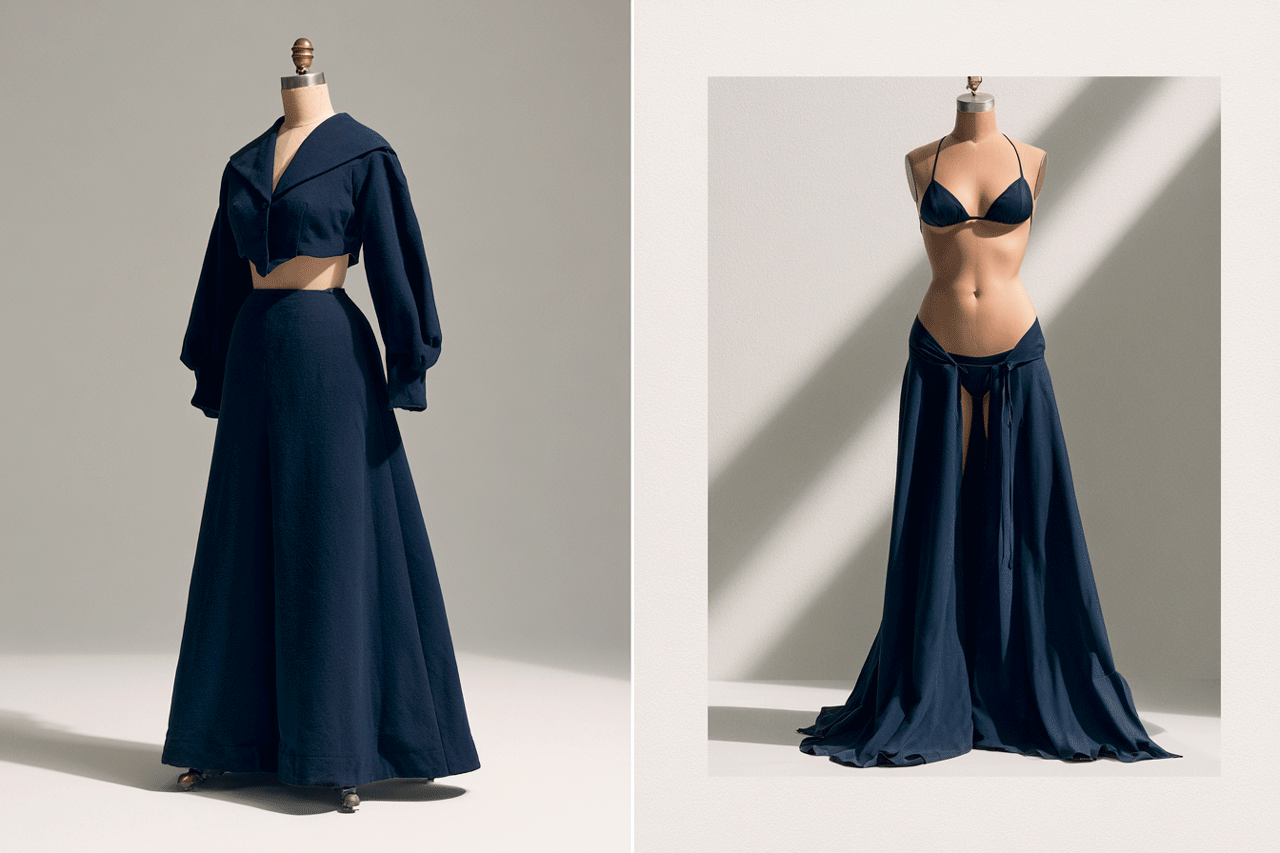
Of all the garments in a woman's wardrobe, none has changed more dramatically in two centuries than the swimsuit. In 1800, a woman entering the sea wore a full-length gown of heavy wool, weighted at the hem to prevent it from floating upward. By 2000, the same occasion required, if she chose, four triangles of nylon held together with string.
The journey between those two points is one of the most fascinating stories in fashion history — not merely about clothing, but about women's bodies, women's freedoms, and the recurring human tendency to be genuinely shocked by whatever amount of skin was currently on display.
1800s: ankle-length wool gown, bathing machines, strict sex segregation. 1907: Annette Kellerman arrested for wearing a one-piece. 1920s–30s: Chanel, the tan, synthetic fabrics. 1946: Louis Réard unveils the bikini in Paris. 1960s: Bardot makes it mainstream. Today: every silhouette, every fabric, every body.
The First Two-Piece
The swimsuit story does not begin in the Victorian era. Ancient Roman mosaics from the fourth century AD depict women exercising and swimming in two-piece garments — a bandeau top and brief bottoms — that bear a striking resemblance to a modern bikini. These garments were apparently unremarkable enough to be the subject of decorative floor mosaics, which suggests that neither the garment nor the skin it revealed was considered remarkable in that context.
Between ancient Rome and the Victorian era, the question of what to wear in the water was largely irrelevant to most people. It was not until the 18th century — when sea-bathing began to be promoted as a medical treatment, and then gradually as a leisure activity — that the question of what to wear in the water became a pressing social concern.
1700s — early 1800sThe Bathing Gown and the Bathing Machine
When European women began entering the sea in significant numbers, the clothing they wore was designed with one overriding priority: the concealment of the female body from any observer, and specifically from any male observer.
The bathing gown was a long, loose chemise reaching to the ankles, with long sleeves, made from wool or flannel — deliberately heavy fabrics, chosen because their weight prevented the garment from floating upward or clinging to the body when wet. Some versions had weights sewn into the hems for additional security.
This was not recreational swimming in any recognisable sense. A woman in a waterlogged wool gown weighing several additional kilograms once wet, descending into the sea from the back of a horse-drawn hut, was not exercising or playing. She was submitting to a medical treatment, or performing an act of social participation in the growing fashion for sea-bathing, that happened to involve getting wet.
 Mid-1800s
Bloomers Arrive
The second half of the 19th century brought the bloomer bathing costume — pairing ankle-length trousers with a tunic-style dress worn over them. Compared to the single weighted gown, this was a meaningful practical improvement: the trousers stayed in place regardless of water movement, and the garment was marginally less impractical for actual movement.
The fabric was still typically flannel or wool, still heavy when wet, and still designed to prevent any suggestion of the body's shape beneath it. Women in most public bathing locations were still using bathing machines, particularly in Britain and the United States, where mixed bathing — men and women in the water at the same time — remained either illegal or socially unacceptable in most locations until the very end of the century.
1900s — 1910sAnnette Kellerman and the First Reform
The reform of the bathing costume began with a swimmer. Annette Kellerman was an Australian professional swimmer and performer who came to the United States and Britain in the early 1900s and rapidly became famous — and infamous — for refusing to swim in the elaborate, impractical bathing costumes that convention required of women.
In 1907, Kellerman was arrested in Boston for indecent exposure — wearing a one-piece swimsuit that revealed her arms and legs. The judge overruled the arrest, agreeing that she could not be expected to compete in a garment that made swimming physically impossible.
The incident was extensively covered in the press. Kellerman's argument — that a garment for swimming should permit the body to move and swim — now seems obvious, but it was genuinely radical in 1907. The decade that followed saw rapid changes in what was considered acceptable.
By 1915, Jantzen Knitting Mills began manufacturing what they called "swimming suits" — a deliberate distinction from "bathing suits," reflecting the new idea that the garment was for active swimming rather than passive immersion. Their suits were fitted knit garments in wool, still covering the body from neck to knee, but considerably more practical than anything that had preceded them. Some beaches employed "swimsuit police" who measured the length of women's suits and fined those whose garments failed to meet required coverage — a detail that is difficult to believe but was a documented reality in several American cities.
1920s — 1930sThe Great Uncovering Begins
The 1920s saw the swimsuit begin its long journey toward minimalism, driven by three factors: the flapper era's rejection of Victorian restriction, the emergence of the tan as a fashionable attribute, and the increasing acceptance of swimming as a sport.
Coco Chanel created a one-piece swimsuit in bouclé fabric that launched a fashion-house interest in swimwear — and she was famously photographed with a tan after a yachting trip in 1923, making tanning associated with leisure and glamour rather than outdoor labour. If the point of beach-going was now partly to tan, garments that minimised coverage were suddenly desirable rather than scandalous.
Austerity Produces Innovation
The wartime period is one of fashion history's more surprising moments of swimsuit evolution. In the United States, wartime fabric rationing required a 10% reduction in the amount of fabric used in swimsuits. Designers who had been moving cautiously toward less coverage were now required by government regulation to use less material.
The result was a generation of two-piece swimsuits — not bikinis in the modern sense, but separates that left a band of midriff visible — that would have been unthinkable a decade earlier. This wartime constraint effectively normalised the two-piece swimsuit at a mass-market level, setting the stage for what was to come in 1946.
 1946
1946
The Bikini
On 5 July 1946, at the Piscine Molitor in Paris, French engineer-turned-designer Louis Réard unveiled a two-piece swimsuit consisting of four triangles of fabric printed with newspaper type. He named it the bikini, after Bikini Atoll, where the United States had conducted atomic weapons tests just four days earlier. His logic was that the garment would be as explosive as the bomb.
Réard could not find a professional model willing to wear the garment, which was so small that it could, he claimed, be pulled through a wedding ring. He eventually hired 18-year-old Micheline Bernardini, a nude dancer at the Casino de Paris, who wore the bikini for its debut and subsequently received over 50,000 fan letters.
Hollywood, Bardot, and the Point of No Return
The 1950s saw the bikini and the fitted one-piece coexist, with the latter being the choice for more conservative markets and the former becoming increasingly associated with glamour and the French Riviera. Esther Williams — an Amateur Athletic Union champion who became the star of a series of aquatic musical films — wore glamorously named costumes designed specifically for her, establishing the swimsuit as a genuine fashion garment.
The 1960s saw the completion of the bikini's transition from scandalous to mainstream. Nylon and Lycra allowed for form-fitting suits in ways that previous materials had not. Rudi Gernreich, the decade's most avant-garde swimwear designer, removed the top entirely from the bikini in 1964 with his monokini — a topless swimsuit that caused genuine international scandal and was, at the time, considered the logical end of a century-long process of uncovering.
The swimwear of the 1960s was also definitively colourful — bold patterns, polka dots, ruffles, and bright solids replaced the relatively sombre palette of preceding decades, as manufacturing made vivid, colourfast prints available at accessible prices.
1970s — 1990sSport, Baywatch, and the Tankini
The 1970s introduced the string bikini, the thong bottom (introduced by Rudi Gernreich, again, in response to a ban on nude sunbathing in California), and a growing differentiation between athletic swimwear and beach fashion. The one-piece maillot enjoyed a fashion revival alongside the bikini, offering a sleeker alternative for women who wanted coverage without the structured formality of 1950s styles.
The 1980s brought high-cut leg openings, bright neons, and the Baywatch-era association of the red one-piece with California beach life. The Baywatch aesthetic — spreading globally after the show first aired in 1989 — had a measurable effect on swimwear sales and silhouettes throughout the early 1990s.
The late 1990s saw the invention of the tankini: a two-piece suit with a tank-top rather than a bra-style top, credited to designer Anne Cole and hailed as the first significant innovation in women's swimwear in decades. It captured nearly a third of the swimwear market within a few years of its introduction.
TodayEvery Shape, Every Fabric, Every Body
The contemporary swimwear market is characterised by a plurality that would be genuinely unrecognisable to every preceding generation. Technical fabrics engineered for competitive swimming sit alongside vintage-inspired high-waisted bikini bottoms. Sustainable swimwear made from recycled ocean plastic has become a significant market segment. Rash guards and long-sleeved swimwear designed for sun protection have their own established fashion aesthetic. Size inclusivity — still imperfect but meaningfully better than a decade ago — has broadened the range of bodies for which fashion-forward swimwear is available.
From the weighted hem of the Victorian bathing gown to the four triangles of the 1946 bikini: the distance between them is not merely the history of a garment. It is the history of how women's bodies have been governed, debated, liberated, and reclaimed — played out, decade by decade, on the beach.
The one constant across all of it: the swimsuit remains one of the most politically charged garments in fashion history. What it reveals, what it conceals, what it signals about the wearer's relationship to her body — none of these questions have simple answers, and swimwear designers, wearers, and observers have been arguing about them for two centuries.
Frequently Asked Questions
When was the bikini invented?
The modern bikini was unveiled on 5 July 1946 at the Piscine Molitor in Paris, by French engineer-turned-designer Louis Réard. He named it after Bikini Atoll, where the United States had conducted atomic weapons tests just four days earlier, reasoning that the garment would be as explosive as the bomb. He could not find a professional model willing to wear it and eventually hired 18-year-old Micheline Bernardini, a nude dancer at the Casino de Paris, who wore the bikini for its debut and received over 50,000 fan letters.
What did Victorian women wear to swim?
Victorian women wore a full-length bathing gown — a loose chemise reaching to the ankles, with long sleeves, made from wool or flannel. These were deliberately heavy fabrics chosen because their weight prevented the garment from floating upward when wet. Some versions had weights sewn into the hems. Women entered the water from bathing machines — wooden huts on wheels pulled by horses into the sea — to ensure their modesty was preserved from the moment they left their street clothes to the moment they entered the water.
Who was Annette Kellerman?
Annette Kellerman was an Australian professional swimmer and performer who came to the United States and Britain in the early 1900s and became famous for both her swimming abilities and her refusal to wear impractical bathing costumes. In 1907, she was arrested in Boston for indecent exposure — wearing a one-piece swimsuit that revealed her arms and legs — but the judge overruled the arrest, agreeing she could not be expected to compete in a garment that made swimming physically impossible. The incident brought the question of women's swimwear into public discourse and directly led to the reform of bathing costumes in the following decade.
When did women start wearing bikinis?
Although the bikini was invented in 1946, it was not widely adopted until the late 1950s and early 1960s. Brigitte Bardot was photographed wearing one on a beach in Saint-Tropez, and the garment subsequently became the symbol of effortless, sun-drenched European freedom. Before this, the bikini was banned in several countries, declared sinful by the Vatican, and rejected by most mainstream fashion markets.
What was a bathing machine?
A bathing machine was a wooden hut mounted on wheels, used by Victorian and Edwardian bathers to enter the sea while preserving their modesty. The bather changed from street clothes into her bathing costume inside the machine, which was then pulled by a horse into the sea until the water was at the appropriate depth. The bather descended into the water via steps at the rear, completely shielded from any observers on the beach.
Sew your own swimsuit
Keep reading

The History of the Party Dress
From Victorian evening gowns to the little black dress — a century of dressing up.
Read more
The History of the Sundress
How the most casual summer garment became the most enduring one.
Read more
The Best Fabrics for Hot Weather
What actually works in real summer heat — and how to choose at the fabric shop.
Read more
Why Navy, White, and Linen Are the Colours of Summer
The history of the palette that never goes out of fashion.
Read more
What Makes a Good Party Dress Pattern
How to choose a pattern that will produce a dress you actually want to wear.
Read more
The Best Colours to Wear in Hot Weather
Why white reflects heat and what the research really shows.
Read more